
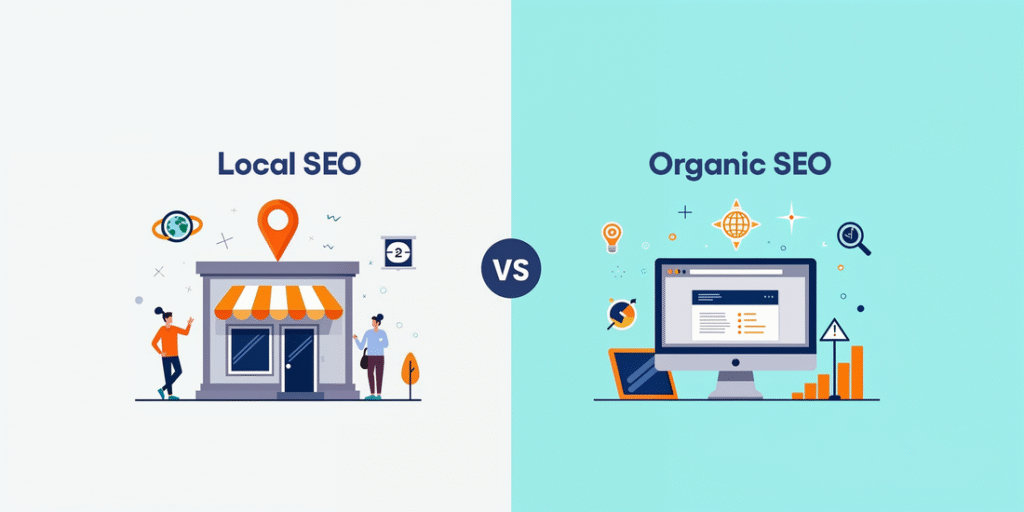
Guide to Organic and Local SEO
Imagine you’re craving coffee, so you search for “coffee near me,” and you find Starbucks at the top of the search list within a second. This demonstrates the power of local and organic SEO. Since Starbucks generates over 6 million monthly visits from organic search alone, ranking for hundreds of thousands of keywords and controlling authority without depending on paid advertisements, local and organic SEO has improved its online visibility and, most notably, has built a powerful brand identity.
Businesses are increasingly embracing SEO in today’s digital age to enhance their content and attract new clients. They optimise material using Google’s algorithms and ranking variables to increase visibility. Whether you are just getting started or trying to optimize your current digital marketing approach, it is crucial to understand both local SEO and organic SEO, as well as the key distinctions between them. This guide will walk you through the fundamentals of each kind of SEO, along with how they can be at your service in growing your business.
What is Organic SEO, and why is it important?
Organic SEO is like a silent salesperson on the internet, that boosts company visibility without requiring you to pay for advertisements and converts searchers into loyal clients. To further elaborate, it’s a process of optimising a website to appear naturally on Google or other search engines without the need for sponsored ads. The real strength of organic SEO lies in its ability to deliver long-term results, and when executed effectively, organic SEO allows your content to steadily rise and even outperform paid campaigns over time.
Organic SEO generates continuous traffic by making your company appear in search results when people are actively searching for you, without requiring you to pay for advertisements. It also increases credibility and trust as people trust top-ranking outcomes more than paid advertisements. In addition to increasing visibility, organic SEO enhances user experience by providing quick, user-friendly, and mobile-friendly content. To put it briefly, organic SEO gives your company long-term development and authority by converting internet searches into actual visitors, leads, and loyal consumers.
The Ultimate Guide to Organic SEO
In this crowded digital marketing world, just being visible is not enough. You need to be precisely visible to those who are actively searching for the kind of services you’re offering. This comprehensive guide will lead you through reliable approaches, insider expertise, and practical actions to become an expert in organic SEO so that your content is not only seen but also converts visitors into devoted clients.
Began with smart keyword research
Use tools like Ahrefs, SEMrush, Google Trends, and Google Keyword Planner to uncover keywords that people are actively searching for. Pay attention to long-tail keywords that are simpler to rank for, have good search intent, and low keyword difficulty.
1. Create content that addresses relevant issues
Create blogs, guidelines, and FAQs that fully and clearly address user enquiries. Popular tools like People Also Ask on Google and AnswerThePublic are two tools that assist in determining what users are interested in.
2 . Optimize on-page SEO effectively
Insert keywords organically into URLs, picture alt text, headings (H1–H3), page titles, and meta descriptions. Make sure on-page optimisation is done appropriately by using tools like Rank Math or Yoast SEO.
3. Boost UX and content readability
Divide the content into bullet points, optimize pictures, and brief paragraphs. Grammarly and Hemingway Editor are two tools that aid with readability and clarity.
4. Resolve Technical SEO Issues
Make sure the website loads quickly, is mobile-friendly, and is properly indexed. To find and address technical issues, use Screaming Frog, PageSpeed Insights, and Google Search Console.
5. Create High-quality Backlinks
Backlinks can be obtained through backlinks from reputable websites through collaborations, guest posts, and relevant content. Backlinks and domain authority can be monitored with the aid of programs like Ahrefs and Moz.
Local SEO and Its Importance
Local SEO is the difference between being nearby and being chosen. When customers search “near me,” the businesses that show up first win the call, the visit, and the sale. Businesses that appear first when consumers search for “near me” earn the call, the visit, and the sale.
Local SEO (Search Engine Optimisation) helps companies rank higher in location-based searches (like “pizza near me”), improving their visibility for clients who are searching on Google Maps and results pages. This is important because it increases foot traffic, online interaction, and earnings for physical shops or service-area enterprises. Concentrating on particular regions rather than just general keywords, it involves optimising your digital presence (website, Google Business Profile, listings) to draw in more business from pertinent local searches. Local SEO assists search engines in determining where your business operates and why it should be recommended through precise location details, optimised local content, feedback from clients, and map appearance. Local SEO converts local search queries into steady business growth by focusing on local demand rather than seeking general traffic.
Local SEO Ultimate Guide
People look for local locations every single day, and the companies that show up first end up being their first choice. If your brand isn’t appearing on maps, local results, or “near me” searches, you’re basically invisible. This comprehensive guide to local SEO explains how to be discovered, selected, and convert local searches into actual clients.
1. Show Up in Local Searches and Map
Make sure your company appears in both the local rankings and Google Maps. You can manage and improve your listings with the support of apps like Moz Local and Google Business Profile.
2. Optimize your Google Business Profile(GBP)
Update all business information, insert images, reply to reviews, and publish updates regularly. You can monitor how customers find your company with Google Business Profile Insights.
3. Search for Relevant Local Keywords
Use tools like SEMrush, Ahrefs, or Ubersuggest to pinpoint the precise keyword that people use. Include these terms in blog entries, meta tags, and website content.
4. Post and Optimize Reviews Online
Urge happy clients to post reviews on Google or websites specific to their particular sector. Reviews can be effectively gathered and tracked with the use of tools like Podium and Grade.us.
5. Optimize For Mobile Friendliness and Fast Loading
Fast loading and mobile optimisation are important because most local searches are conducted on mobile devices. To enhance speed and user experience, use GTmetrix or Google PageSpeed Insights.
6. Monitor Local SEO Performance
To find out how well your local SEO efforts are working, use Google Analytics, Google Search Console, or Local Falcon to track rankings, traffic, and leads.
Organic SEO vrs Local SEO
Let’s say you are looking for “emergency car repair in Coventry” at midnight. A local garage in Coventry that appears first on Google Maps instantly receives the call right away. This is Local SEO inaction. In contrast, you might search for “how to fix your car engine,” and a blog will appear, which might appear on Google and draw readers from all over the nation, but it won’t bring in local clients right away. Now, that’s organic SEO. In general, Local SEO generates immediate local traffic while the other increases authority and reach over time.
Organic SEO targets a large, worldwide audience for general research (e.g., “best pizza recipes”), emphasising quality content, backlinks, and site authority. Meanwhile, Local SEO focuses on local clients for in-person visits (e.g., “pizza near me”) and focuses on Google Business Profiles & feedback. The best strategy often combines both for in-depth visibility. Now, neither is necessarily better as they have different purposes. While an e-commerce store wants organic SEO for sales and a restaurant needs SEO for foot traffic, plenty of companies gain the most from a mix of both that gives maximum reach.
Final Thoughts
Local SEO and organic SEO are ultimately two parts of the same growth engine by the end of the day. While organic SEO increases the status of your brand and attracts customers from various markets and regions, local SEO makes your company visible to the people who are closest to you and most willing to take action.
To sum up, both local and organic SEO are essential for developing a powerful online presence. While organic and local SEO have a long-lasting effect, paid search can supplement these tactics by offering instant exposure. Businesses can increase traffic, foster trust, and achieve ongoing growth in the cutthroat digital marketplace by comprehending and utilising both.
FAQs
What distinguishes organic SEO from local SEO?
Each has a distinct function. While organic SEO makes it easier for anyone to find your company online, local SEO guarantees that people in the area will specifically find you in person.
What is Organic SEO?
Organic SEO basically means using specific techniques or resources to improve a website’s content in the “free” search results. By using browser extensions and plugins, users can list only organic results and avoid advertisements in search results. Different ad-blocking tools may have been developed for other browsers.
Does my business need both organic and local search engine optimisation?
Yes, especially for the majority of companies that have a physical site or service area. They function as two sides of the same coin: Organic SEO increases your overall brand authority and helps you rank for more general industry searches, while local SEO assists local customers in finding your store.
What are the most crucial ranking factors for Local SEO?
Google gives priority to three primary factors for local search:
Relevance: The degree to which your company profile aligns with the user’s search query.
Distance: The distance between your company and the searcher.
Prominence: Your company’s level of recognition as determined by reviews, backlinks, and directory listings.
What are the foundations of an organic SEO strategy?
Three key components make up an organic strategy:
Technical SEO: Enhances the structure, mobile friendliness, and speed of a website.
On-page SEO: Creating excellent content and optimizing it for relevant keywords.
Off-page SEO: Creating high-authority backlinks from other respectable websites.
Is SEO more affordable than paid advertising (SEA)?
Paid advertisements demand a steady budget even though they offer instant visibility. Since you don’t have to pay for each hit after you rank organically, SEO is ultimately more economical. Additionally, compared to sponsored ads, people frequently view organic results as more reliable and trustworthy.