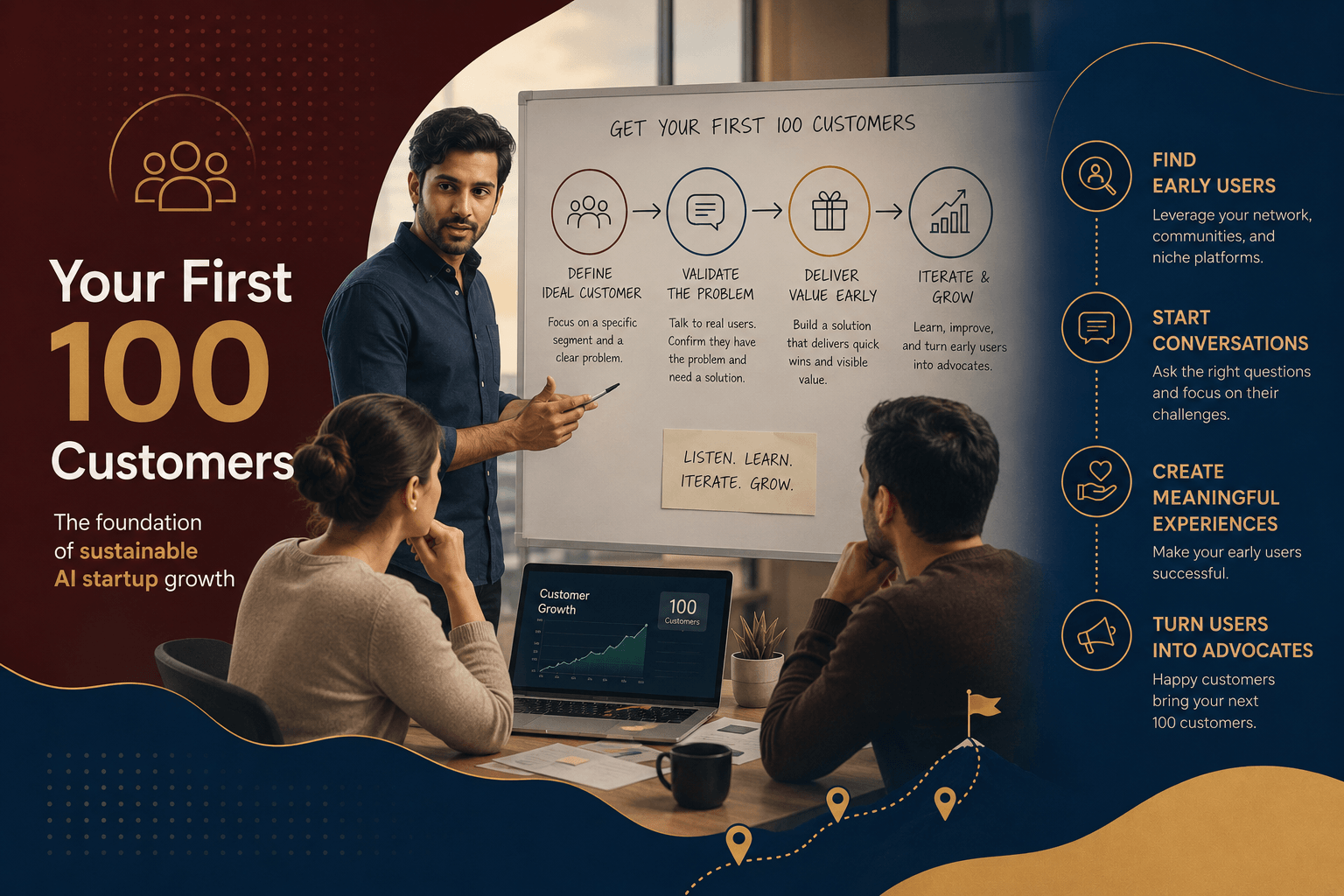
Landing your first 100 customers is arguably the hardest and most important milestone for any AI startup. Unlike traditional SaaS products, AI solutions often face additional hurdles. These include longer education cycles, trust concerns, and the need to prove real value over hyped promises.
After observing dozens of successful AI startups and speaking with founders who have crossed this critical threshold, here is a practical roadmap to get your first 100 customers.
1. Start With a Painfully Specific Problem
The biggest mistake AI startups make is building a general purpose AI solution that solves everything but excels at nothing.
Instead, go narrow. Target one industry. For example, focus on legal document review for real estate attorneys. Solve one specific pain point, such as reducing contract review time by 80 percent. Focus on a defined user persona, like solo practitioners with 5 to 20 clients.
Your first 100 customers will not come from a broad appeal. They will come from being the perfect solution for a small, desperate audience.
Write down your ideal customer’s biggest pain point in one sentence. If you cannot, you are not focused enough.
2. Build in Public and Educate Relentlessly
AI is still mystifying for many potential customers. Your job is not just to sell. It is to educate.
Effective channels for AI startups include Twitter or X threads where you break down how your AI works and share behind the scenes development. LinkedIn articles help you position yourself as a thought leader in your niche. YouTube demos show your product in action solving real problems. Weekly blog posts with SEO optimized content address your customer’s pain points.
The founders who consistently share their journey, learnings, and insights build trust faster than any ad campaign.
Commit to creating one piece of educational content per week for 12 weeks.
3. Give Away Your Expertise Before Your Product
Before anyone pays for your AI solution, prove you understand their world deeply.
Offer free audits. Say something like, “We will analyze 10 of your support tickets and show you where AI could save time.” Create free tools such as calculators, assessments, or simple versions of your core tech. Host workshops or webinars teaching skills adjacent to your product. Publish original research or case studies in your target industry.
When you solve smaller problems for free, people trust you with their bigger paid problems.
Design one free offering you can deliver this week that showcases your expertise.
4. Leverage the Founder Network Strategy
Your network is your net worth, especially for your first customers.
Tap into former colleagues who know your capabilities and trust you. Engage with industry communities such as Slack groups, Discord servers, and Reddit communities where your target customers hang out. Partner with complementary tool makers that serve the same audience but do not compete directly. Join accelerators and incubators that give you access to potential customers and mentors.
Do not cold email 1,000 strangers. Warm introductions from trusted sources convert 10 to 50 times better.
List 20 people in your network who either are your ideal customer or know lots of them. Reach out to 5 this week.
5. Offer a Ridiculously Good Pilot Program
Your first customers are taking a huge risk on you. Make it irresistible.
A pilot program could include free service for 30 to 60 days with white glove onboarding. You could offer deeply discounted founding member pricing locked in for 12 months. A money back guarantee if specific KPIs are not hit can build trust. Co-creation opportunities where customers help build exactly what they need also work well.
Yes, you will do work that does not scale. That is precisely the point.
Design a founders offer so good that saying no feels like leaving money on the table.
6. Master One Acquisition Channel First
Spreading yourself thin across ten channels gets you nowhere. Pick one, master it, and then expand.
For B2B startups, LinkedIn outreach with personalized connection requests and value first messaging works well. Industry forums and communities where you provide helpful advice rather than sales pitches are effective. SEO driven content including long form guides targeting high intent keywords also delivers results.
For B2C or prosumer products, a Product Hunt launch can generate hundreds of early users. Reddit and other niche communities with authentic participation in relevant subreddits are valuable. Twitter engagement where you reply to potential customers problems with helpful insights can build momentum.
Choose one channel and commit 70 percent of your marketing time to it for the next 8 weeks.
7. Obsess Over Your First 10 Customers
Your first 10 customers are worth 100 times more than customers number 91 to 100.
Why? Because they will give you brutally honest feedback. They will become case studies and testimonials. They will refer you to similar companies. They will validate or invalidate your positioning.
Treat them like gold. Offer personal onboarding calls every single time. Schedule bi weekly check ins asking what is not working. Provide direct Slack or WhatsApp access to you or your co founder. Involve them in product roadmap decisions.
After signing customer number 1 through 10, schedule a 30 minute call to understand their world deeply.
8. Build a Referral Engine From Day One
Your best salespeople are happy customers.
Offer significant incentives such as free months, cash, or service upgrades. Make the referral process effortless with email templates, one click sharing, and unique referral links. Ask at the moment of delight, right after a win or positive feedback. Showcase existing customers publicly with permission to build social proof.
One satisfied customer can easily bring you 3 to 5 similar customers if you ask and incentivize correctly.
Create a simple referral program offering your customers clear value for introductions.
9. Do Not Fear Manual Processes
AI startups often feel pressure to be fully automated from day one. This is a mistake.
What you should do manually at first includes customer onboarding and training, data preprocessing and cleanup, feature customization for key accounts, and feedback collection and analysis.
These unscalable activities teach you what needs to be automated and what actually delivers value.
Make a list of what you are doing manually. Keep doing it until you have at least 20 customers.
10. Showcase Real Results, Not Just Features
Nobody cares about your model’s accuracy or your tech stack. They care about outcomes.
Instead of saying your AI uses transformer based architecture, say your customers reduce customer support response time by 65 percent.
Create proof through before and after comparisons. Provide ROI calculators. Gather video testimonials. Publish public case studies with real numbers.
Document the results of your first 5 customers meticulously. Turn them into case studies.
11. Leverage AI Directories and Marketplaces
Get discovered by people actively searching for AI solutions.
List your product on Product Hunt, There’s An AI For That, and AI tool directories like Futurepedia and AI Valley. Industry specific tool comparison sites like G2 and Capterra also work well. GitHub is another option if applicable.
Most submissions are free and can drive consistent early traffic.
Submit your product to 5 relevant directories this week.
12. Host Live Demos and Webinars
Showing is more powerful than telling, especially with AI products.
Effective formats include weekly open demos at the same day and time each week. Industry specific webinars partnered with communities or influencers work well. Problem solving sessions where you invite people to bring their data or problem and show what AI can do are valuable. Q and A sessions addressing common concerns about AI build trust.
Record everything and repurpose into content.
Schedule your first open demo for 2 weeks from today and promote it across your channels.
The Reality Check
Let us be realistic. Customers 1 through 10 might take 2 to 4 months of intense hustling. Customers 11 through 50 might take another 2 to 3 months as word spreads and you refine your messaging. Customers 51 through 100 might take 1 to 2 months as momentum and social proof compound.
The total timeline is roughly 6 to 9 months of focused, consistent effort.
This is not a sprint. It is a strategic grind.
Common Pitfalls to Avoid
Do not wait for the perfect product. Ship something useful quickly.
Do not hide behind your keyboard. Talk to humans constantly.
Do not compete on AI hype. Compete on solving real problems better.
Do not ignore feedback. Your first customers are giving you gold.
Do not try to appeal to everyone. Niche down ruthlessly.
Do not neglect onboarding. A confused customer churns quickly.
Your 30 Day Action Plan
Week 1: Define your ultra specific target customer. Create one high value free offering. Reach out to 10 warm connections.
Week 2: Launch on 5 AI directories. Publish 2 pieces of educational content. Schedule your first open demo.
Week 3: Run a pilot program with your first 2 to 3 customers. Get detailed feedback and iterate. Create testimonials or case studies from results.
Week 4: Refine your pitch based on learnings. Launch your referral program. Double down on what is working.
Final Thoughts
Getting your first 100 customers as an AI startup is not about having the most sophisticated algorithms or the biggest funding round. It is about solving a real, specific problem better than alternatives. It is about building trust through education and transparency. It is about treating early customers like the invaluable partners they are. It is about staying focused on one channel and one niche. And it is about iterating relentlessly based on real feedback.
The AI hype cycle will come and go. What remains are the startups that genuinely make their customers’ lives better.
Now stop reading and go talk to a potential customer.
If you found this guide helpful, share it with a fellow founder. If you have questions about your specific situation, drop them in the comments below.