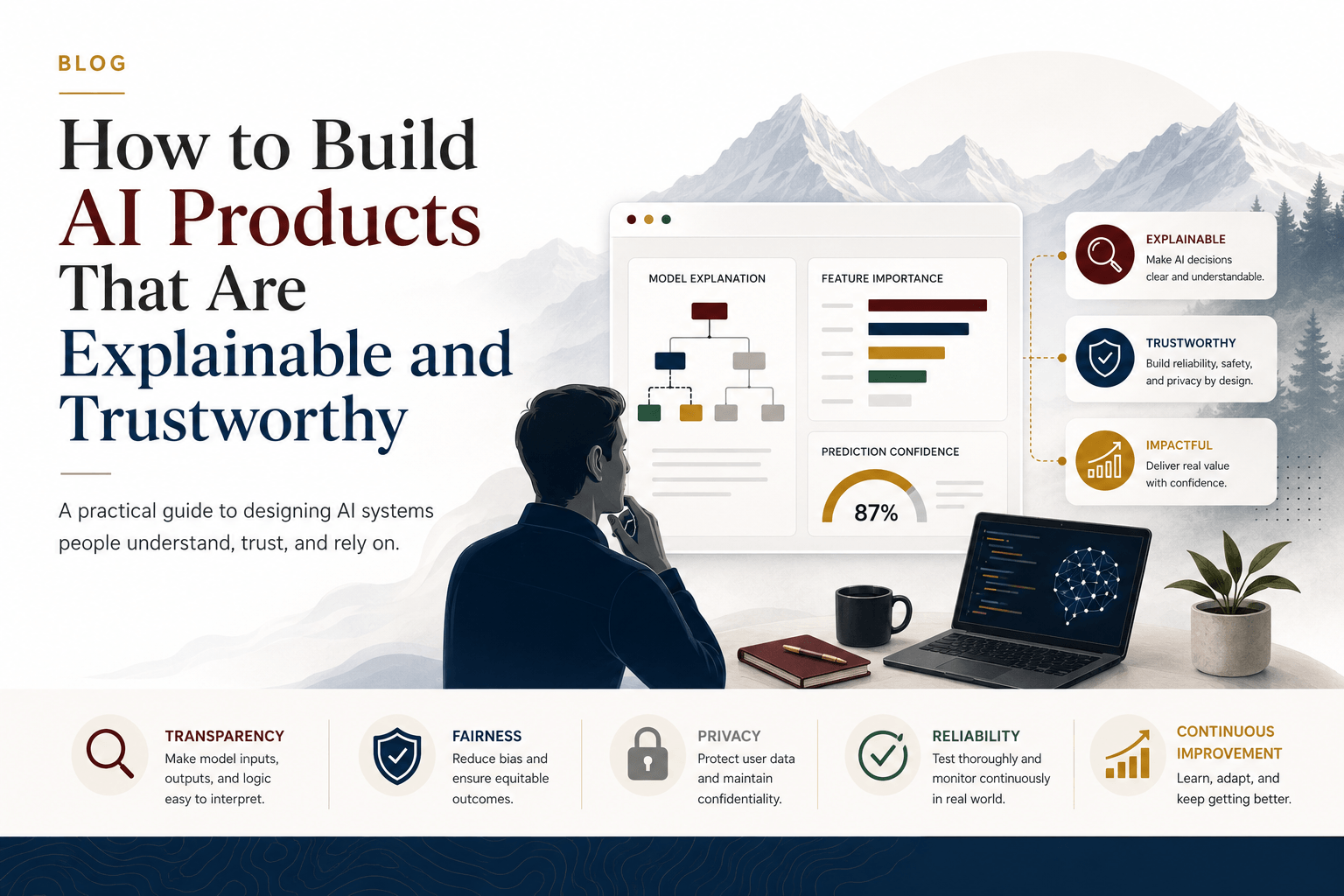
As AI moves into healthcare, finance, education, and government, users no longer just care whether the model “works.” They want to know why it reached a decision, whether it is fair, and how to trust it day to day. Building AI that is explainable and trustworthy is no longer optional, it is a core design requirement for any product meant for real‑world use.
Start With a Clear Purpose and Boundaries
Explainability begins long before you write the first line of code.
- Define exactly what problem your AI is solving and what it is not responsible for.
- Set clear boundaries on when the system should hand off to a human, when it should refuse to act, and when it should admit uncertainty.
When users understand what the AI is for and what it is not, they find it easier to trust, even if it is imperfect.
Choose the Right Model for Interpretability
Not every problem needs a deep neural network.
- Use simpler, more interpretable models, such as decision trees, linear models, or rule‑based systems, for high‑stakes use cases unless you have a strong reason to use complex models.
- When you do use complex models, pair them with post‑hoc explanation methods such as SHAP, LIME, or feature‑importance dashboards.
The goal is not to sacrifice performance needlessly, but to ensure that the model’s logic can be audited and understood by domain experts and stakeholders.
Design Transparency Into the User Experience
Trust grows when the AI communicates clearly, not just when it performs accurately.
- Show users key factors that influenced the result, such as “This recommendation is based on your past purchases and location.”
- Provide simple confidence scores, uncertainty indicators, or “case‑based” explanations that surface similar decisions from the past.
Avoid hiding the AI behind a black box. Instead, make the decision logic visible in ways that match the user’s level of expertise.
Make Fairness and Bias a Core Metric
Explainability is not just about how the model works; it is also about how it treats different people.
- Define sensitive attributes early (such as gender, age group, or region) and regularly check for disparate impacts using fairness metrics.
- Log and visualize how predictions differ across groups and allow teams to adjust thresholds or data pipelines when disparities appear.
A trustworthy AI product measures fairness as rigorously as it measures accuracy or latency.
Log, Audit, and Version Everything
A trustworthy AI system must be auditable and repeatable.
- Log inputs, model versions, and outputs so that you can reconstruct decisions months later.
- Track model performance and data drift over time, and set up alerts when the system starts to deviate from expected behavior.
When regulators, customers, or internal teams ask “What happened here?” you should be able to answer with concrete logs and version history.
Let Users Correct and Learn From Mistakes
Explainability is not a one‑way pipeline from the model to the user.
- Build feedback loops where users can flag incorrect or unfair predictions and provide corrections.
- Use this feedback to retrain or fine‑tune models while keeping a clear record of how the system has evolved.
Users begin to trust AI when they feel they can influence and improve it, not just passively accept its output.
Document Your AI’s “Rules of Behavior”
Every AI product should come with what some teams call an “AI constitution” or “behavior charter.”
- Write down data sourcing rules, privacy safeguards, allowed use cases, and red‑line scenarios where the model must not be used.
- Share this documentation with customers, partners, and internal teams so expectations are explicit and aligned.
Clear documentation reduces misunderstandings and creates accountability when the system behaves in unexpected ways.
Test With Real‑World Users, Not Just Benchmarks
It is easy to optimize for test‑set scores, but real trust is built in messy, everyday use.
- Run pilot tests with real users in their actual workflows and observe how they interpret explanations and warnings.
- Ask questions like “Would you trust this recommendation with your own money?” or “Would you rely on this in a life‑critical situation?”
Adjust both the model and the interface until users feel confident enough to act on the AI’s output.
Final Thought
Explainable and trustworthy AI is not just about adding a “why” button. It is about designing systems that are interpretable by default, fair by design, auditable over time, and collaboratively improvable with users. When you treat explainability as a product quality, not an afterthought, your AI becomes something people are willing to rely on, not just something they tolerate.