There is a quiet shift unfolding inside modern businesses, one that doesn’t arrive with noise, but with relief. It shows up in the absence of cluttered inboxes, in the disappearance of manual spreadsheets, in the sudden lightness of a workday that once felt endlessly repetitive. Artificial Intelligence has stepped into the rhythm of work not as a replacement for people, but as a silent partner, absorbing the mundane, refining the routine, and returning time to where it truly belongs.
For decades, companies have been built on systems that required human attention for even the smallest actions. A form had to be checked. A number had to be entered. A report had to be compiled. Individually, these tasks seemed harmless. Collectively, they formed a quiet drain, hours dissolving into processes that demanded effort but offered little creative or strategic value. Businesses didn’t question it because it was normal. Repetition was simply part of the job.
AI is changing that assumption.
Today, what once required manual oversight is being handled by intelligent systems that learn patterns, recognize intent, and execute with precision. A customer query no longer waits in a queue to be sorted, it is understood instantly, categorized, and either resolved or routed with context already attached. Financial data no longer sits in scattered formats waiting to be cleaned, it is structured, verified, and processed in real time. Marketing campaigns are no longer static plans, they evolve dynamically, adjusting themselves based on performance signals as they unfold.
The transformation is not dramatic in appearance, but it is profound in impact. Workflows begin to move differently. Bottlenecks loosen. Delays shrink. The invisible weight of repetition starts to lift. And what replaces it is something far more valuable, clarity.
When repetitive tasks are automated, employees are no longer tethered to the mechanics of work. They begin to operate at a level that demands thought rather than motion. Instead of spending hours preparing reports, they interpret them. Instead of managing endless back-and-forth communication, they focus on building relationships. Instead of reacting to processes, they begin to shape them.
This shift changes not just productivity, but perspective.
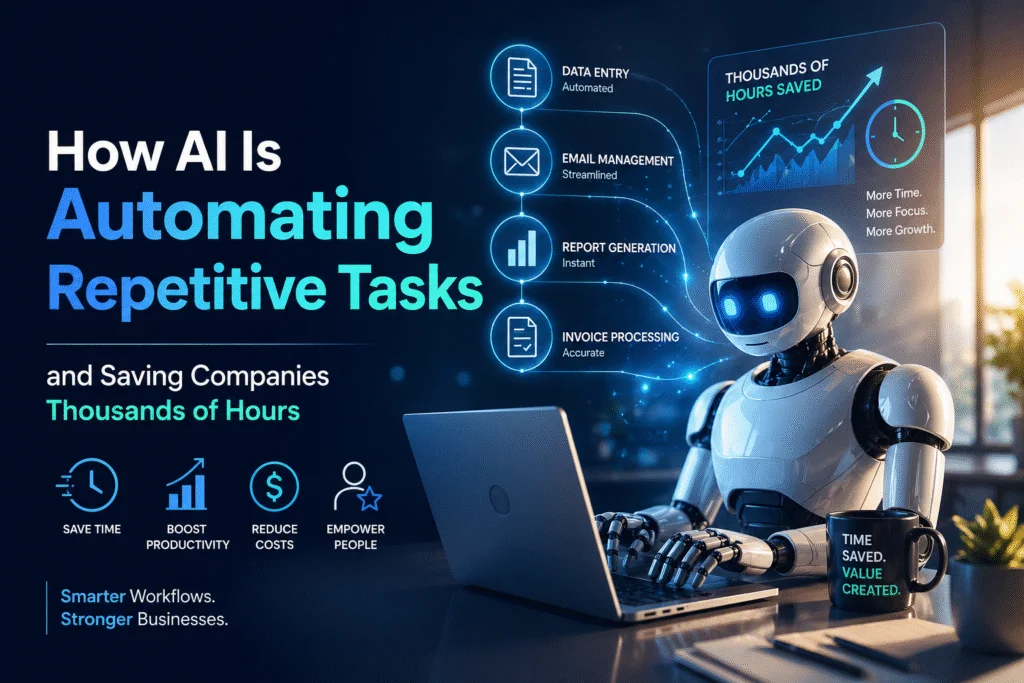
Time, in this new environment, becomes fluid. A task that once consumed an afternoon now takes minutes. A workflow that required coordination across multiple people now runs seamlessly in the background. These small efficiencies compound quietly, and over weeks and months, they turn into something measurable, thousands of hours reclaimed.
But the real story is not just about hours saved. It is about what those hours become.
They become strategy sessions that were once postponed. They become creative explorations that were once considered luxuries. They become moments of focus in a work culture that was previously fragmented by constant interruptions. Companies begin to notice that their teams are not just working faster, they are working better.
There is also a subtle but powerful shift in accuracy. Repetitive tasks, when handled manually, carry the risk of human fatigue. Even the most careful employee can make small errors when performing the same action repeatedly. AI removes that variability. It executes with consistency, ensuring that data remains clean, processes remain reliable, and outputs remain stable.
This consistency builds trust, not just within teams, but across entire systems.
Decisions become more confident because they are based on dependable information. Operations become smoother because they are no longer interrupted by preventable mistakes. The organization begins to feel more cohesive, not because people are working harder, but because the system itself is working smarter.
And yet, one of the most misunderstood aspects of AI is the idea that it replaces human value. In reality, it refines it. AI does not eliminate the need for people; it elevates the nature of their contribution. It takes over what is predictable so humans can focus on what is not. It handles structure so humans can explore possibility. It manages repetition so humans can bring insight.
In this balance, a new kind of workplace emerges, one where technology and human intelligence are not competing forces, but complementary ones.
Consider the emotional impact as well. Repetitive work, over time, can lead to disengagement. When roles are defined by routine rather than purpose, motivation begins to fade. By removing the monotony, AI allows employees to reconnect with the parts of their work that feel meaningful. They are no longer just completing tasks; they are contributing ideas, solving problems, and driving outcomes.
This change is not just operational, it is cultural.
Teams become more engaged because their work demands presence and thought. Leaders gain more visibility because systems provide real-time insights. Organizations become more adaptive because they are no longer slowed down by manual constraints.
Even smaller companies, once limited by resources, are finding themselves able to operate with the efficiency of much larger organizations. AI tools allow them to scale processes without scaling effort. A small team can now manage volumes of work that would have previously required an entire department. This levels the playing field in ways that were unimaginable just a decade ago.
Of course, this transformation does not happen automatically. It requires intention. Businesses must identify which processes are truly repetitive, where inefficiencies exist, and how AI can be integrated without disrupting the human experience. The goal is not to automate everything, but to automate what should never have required human energy in the first place. When done thoughtfully, the results are unmistakable. Work becomes lighter, but not less meaningful. Systems become faster, but not impersonal. Companies become more efficient, but also more human.
There is a certain elegance in this shift. The idea that progress is not about adding more, but about removing what no longer serves. AI, in this sense, is not just a tool, it is a filter. It strips away the unnecessary, leaving behind space for what truly matters. And perhaps that is the most compelling part of this evolution.
In saving time, AI is not just improving productivity. It is redefining how time is experienced within organizations. It is turning work from a series of repetitive actions into a landscape of thoughtful contribution. The hours that once disappeared into routine are now being reinvested into growth, innovation, and connection. Quietly, steadily, almost invisibly, AI is giving companies something they didn’t realize they had lost. Not just thousands of hours. But the freedom to use them well.